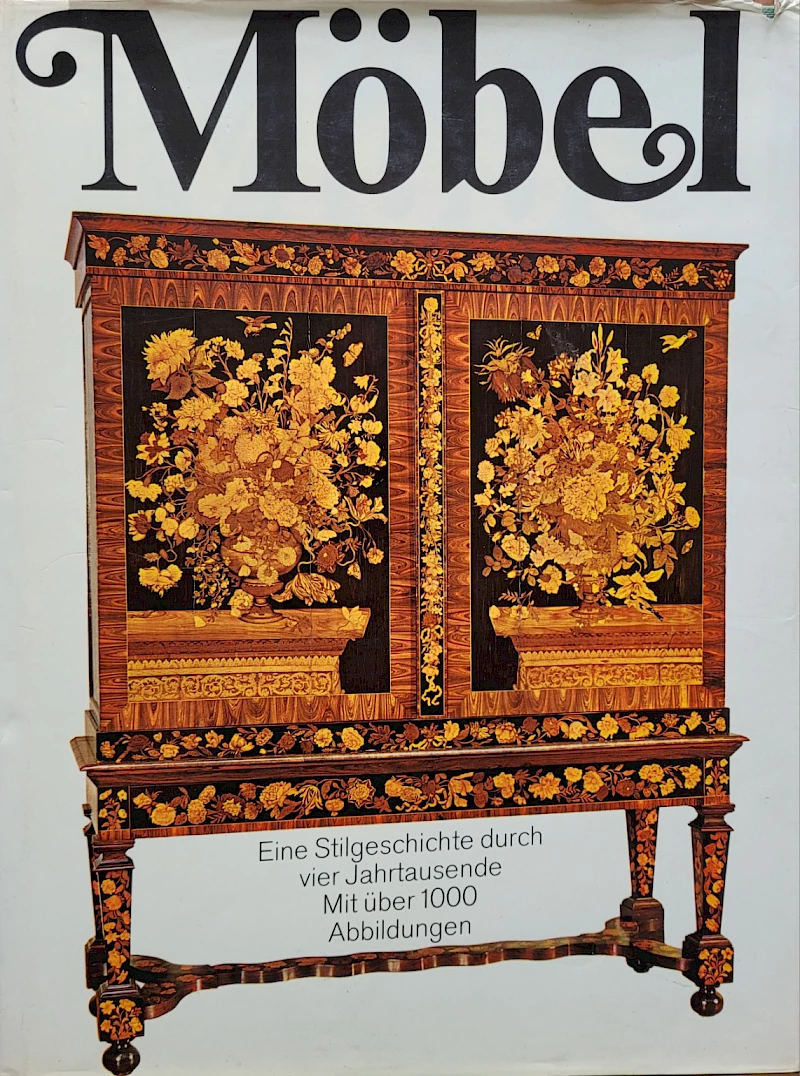
Möbel - Eine Stilgeschichte durch vier Jahrtausende
This monumental survey work covers the development of furniture art from antiquity to modernity and is one of the most comprehensive accounts of the history of furniture in the world. Around 25 specialist authors from six countries analyse the respective stylistic, functional and cultural-historical features. Over 1,200 illustrations - many in colour - illustrate the explanations. The German edition was published in Munich in 1976 and has been editorially revised.
Antiquity (Egypt, Greece, Rome):
Early evidence of mobile interiors, mostly ceremonial or functional in character. Materials such as ebony, bronze or ivory demonstrate a high level of craftsmanship. The furniture forms are clear and formally balanced.
Middle Ages:
Simple, robust furniture made of oak or softwood, often part of the architecture (chests, benches, wall panelling). The ornamental design follows Romanesque and Gothic forms. Functionality takes centre stage.
Renaissance (15th-16th century):
The rediscovery of antiquity gave rise to new forms such as cassoni, credenzas and representative tables. Influences from Italy spread northwards; inlays, carvings and architectural elements characterise the furniture.
Baroque and Rococo (17th-18th century):
Furniture design reaches a new level of splendour. In France, Germany and England, standardised forms emerge (commode, cabinet, console table). Rococo brings forth playful, asymmetrical forms and elegant proportions.
18. 18th century:
The age of classicism. The influence of antique models is rationalised and translated into clear, symmetrical forms. English furniture art is particularly emphasised in this volume - with masters such as Chippendale, Hepplewhite and Sheraton.
19. 19th century:
The industrial revolution brings mass production and style pluralism: historicism, neo-Gothic, neo-Renaissance and neo-classicism stand side by side. The "Arts and Crafts" movement in England presents itself as a counter-movement to industrial mass production.
20. 20th century:
Global communication favours a mixture of national styles. Scandinavian and American design gain influence. The use of synthetic materials (e.g. plywood, tubular metal, plastic) opens up new structural possibilities.
Furniture. A history of style through four millennia.
German edition edited by Wolfgang Vagemuth and Jutta Fanurakis
Ebeling Verlag, 1976. (Original edition: World Furniture, London: The Hamlyn Publishing Group Limited, 1965)
Auch interessant

Jean-Dominique Augarde - A Journey Through Clocks. Masterworks of the Parnassia Collection. Volume 2
The second volume of A Journey Through Clocks is dedicated to the so-called "Pendules au Noir" - French figurative [...]weiter lesen

Uwe Dobler - Barock-Möbel
A practice-orientated reference work on bourgeois furniture art of the 18th century with a focus on German-speaking [...]weiter lesen

Heinrich Kreisel - Die Kunst des deutschen Möbels - Spätbarock und Rokoko
Probably the most important standard work on German Baroque and Rococo furniture of the 18th century. [...]weiter lesen