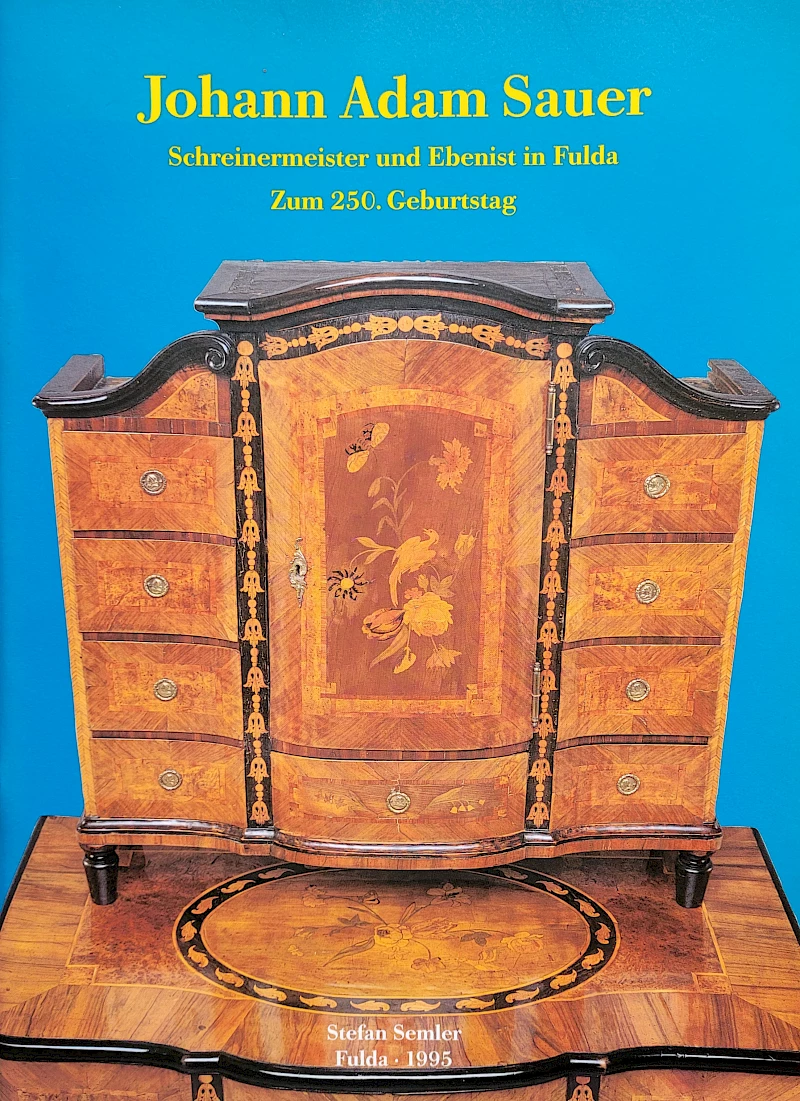
Stefan Semler - Johann Adam Sauer - Schreinermeister und Ebenist in Fulda
Johann Adam Sauer came from a family of carpenters in Fulda, whose craftsmanship can be traced back several generations. As early as the 18th century, his family was closely associated with the carpentry trade and had its own workshop in Peterstraße (now Florengasse). As was customary in the guild trade, Sauer completed a structured training programme with an apprenticeship, journeyman's period and subsequent master craftsman's examination.
At the age of 24, he was granted citizenship of the city of Fulda (1769) and married Maria Agnes Sauer, née Ritz, in the same year. As a master carpenter, he mainly created high-quality furniture in the style of the late Rococo and early Classicism. His work demonstrates a high standard of design and perfect craftsmanship.
Sauer gained particular significance in the regional arts and crafts environment: at a time of economic restructuring (porcelain manufactory, town remodelling under Prince-Bishop Heinrich von Bibra), he asserted himself with sophisticated furniture. Stylistically, he evidently orientated himself on models such as Carl Philipp Arndt and the famous Roentgen manufactory in Neuwied.
Sauer remained active in Fulda throughout his life and was buried in 1822 at the age of 76.
Author / Publisher: Stefan Semler
Place of publication: Fulda
Publisher: Stefan Semler
Year of publication: 1995
Contents: Biography, documentation of works, art-historical and urban-historical categorisation
Auch interessant

Helmut Krieg - Uhrmacher im Bergischen Land – Die Meister und ihre Werke
Interesting book on the subject of the "Bergische grandfather clock" of the 18th and 19th centuries. [...]weiter lesen

Carstensen - Reinke - Die Zeit vor Augen - Standuhren in Westfalen
The most important specialised book on the subject of the Westphalian longcase clock in the 18th and 19th centuries [...]weiter lesen

Biedermeiers Glück und Ende - Die gestörte Idylle 1815–1848
The 750-page publication provides a good basis for analysing the Biedermeier period, and not just in furniture [...]weiter lesen